Written by the King Villa Vung Tau team. Last updated November 2026. Prices and opening hours change often, so please check before you go.
The classic Vung Tau seafood orders are bánh khọt (30,000–100,000 VND a tray), stingray hotpot (150,000–400,000 VND a pot), crab noodle soup, grilled oysters and snails. Live seafood is priced per kilogram: you pick it from a tank, it is weighed, and you pay for the cooking style or a 10,000–100,000 VND cooking fee on top.
- Live crab, prawns, fish and shellfish in Vung Tau are sold by the kilogram, so the bill depends on the weight you choose, not on a fixed plate price.
- At Xóm Lưới Market (Chợ Xóm Lưới), blue swimmer crab runs about 150,000–350,000 VND per kg (about $6–13.50) and clams about 40,000–60,000 VND per kg (about $1.50–2.30).
- Market stalls cook your purchase for roughly 10,000–40,000 VND per kg; restaurants that cook seafood you bring in charge about 30,000–100,000 VND per dish.
- A tray of 10–12 bánh khọt costs about 30,000–100,000 VND (about $1.15–3.85), and a stingray hotpot for two about 150,000–400,000 VND (about $5.80–15.40).
- A seafood dinner for two costs roughly 200,000–500,000 VND at the casual cafés on Trần Phú and 600,000–1,500,000 VND at a large seafront restaurant such as Gành Hào.
- Crab and prawns are generally at their best from December to March; oysters, squid and fish are available all year.
- Always ask the price per kg, the weight and the cooking fee before anything goes to the kitchen.
What is Vung Tau seafood known for?
Vung Tau seafood is known for small, inexpensive local dishes built around the daily catch, plus live crab, prawns, squid and shellfish sold by weight and cooked to order. The city sits on a peninsula with working fishing harbors, so boats land close to the markets and restaurants. The signature bite is bánh khọt, a crisp little rice cake topped with shrimp, followed closely by stingray hotpot.


Photos: 1) Joshua Rappeneker, CC BY-SA 2.0; 2) Phương Huy, CC0; 3) Phương Huy, CC0; via Wikimedia Commons.
The photos above show bánh khọt the way most visitors first meet it: batter sizzling in a round mould, cakes topped with shrimp or squid, and the big basket of herbs and lettuce that always comes with them. That basket is a good summary of how people eat here. Seafood is rarely served alone. It arrives with greens to wrap it in, a dipping sauce made for that one dish, and usually a plate of something sour to cut the richness.
Which Vung Tau dishes should you order first?
Order bánh khọt first, then stingray hotpot, then a round of grilled oysters and snails; those three cover the dishes the city is best known for. After that, add crab noodle soup or squid noodle soup for breakfast and a few items by weight for dinner. Here is what each dish is and how it is eaten.
Bánh khọt (mini shrimp rice cakes). These are crisp, bite-size cakes of rice flour and coconut milk cooked in round moulds and topped with shrimp, shrimp powder and scallion. You wrap one in lettuce and herbs, add shredded green papaya, and dip it in sweet-sour fish sauce. A tray of 10–12 pieces costs about 30,000–100,000 VND (about $1.15–3.85), depending on the shop and the topping. Bánh khọt is a morning and lunchtime food; the best-known shops close in mid-afternoon.
Lẩu cá đuối (stingray hotpot). This is a sour and spicy broth with pickled bamboo shoots (măng chua) in which chunks of stingray are simmered at the table. It comes with rice vermicelli (bún) and a plate of greens, and it is served all year. Stingray has soft cartilage instead of small bones, so it is easy to eat, even for children. Expect about 150,000–300,000 VND for a standard pot, and up to about 400,000 VND (about $15.40) for a larger one for two hungry people.
Hàu nướng mỡ hành and ốc (grilled oysters and snails). Oysters are grilled on the half shell with scallion oil and usually crushed peanuts; they are priced per piece, about 30,000–50,000 VND each (about $1.15–1.90) at restaurants. “Ốc” covers a whole family of snails and shellfish that are grilled, steamed, or stir-fried with tamarind, coconut milk, garlic butter or lemongrass. Names to look for are ốc hương (sweet sea snail), ốc vú nàng, ốc tỏi, sò lụa (a small clam), nghêu (clam) and sò điệp (scallop).


Photos: 1) Phương Huy, CC BY-SA 4.0; 2) Phương Huy, Public domain; 3) Phương Huy, Public domain; 4) Phương Huy, Public domain; via Wikimedia Commons.
The gallery above shows the usual shellfish round: oysters with scallion oil, grilled scallops, stir-fried snails and a bowl of steamed clams. This is sharing food. A group typically orders four or five small plates, each cooked a different way, and eats them slowly with cold drinks. At the street-style places on Trần Phú, plates of snails are listed at roughly 20,000–50,000 VND (about $0.75–1.90) as of November 2026, check locally.
Bánh canh ghẹ (crab noodle soup). Thick, chewy noodles sit in a crab broth with picked crab meat and a slice of crab cake. A bowl costs about 60,000–100,000 VND (about $2.30–3.85). It works as breakfast or a light lunch.
Hủ tiếu mực (squid noodle soup). This is a clear noodle soup topped with fresh squid, and locals eat it for breakfast. It is the gentlest way to start a seafood day, with no shells to crack.
Oysters three more ways. Cháo hàu is oyster rice porridge, mild and filling. Hàu né is an oyster skillet served sizzling, from about 45,000 VND (about $1.75), and a handful of places on Hoàng Diệu are known for it.
Gỏi cá mai (white anchovy salad). Small white anchovies are served raw, dressed and rolled with herbs. It is a local specialty, but it is raw fish, so read the safety section below before ordering.
Seafood by weight. The main event at dinner is usually something from the tank: ghẹ (blue swimmer crab), cua (mud crab), tôm tít or bề bề (mantis shrimp), tôm mũ ni (slipper lobster), tôm hùm (lobster), cá mú (grouper) or cá bớp (cobia). Mực một nắng, squid dried in the sun for a single day and then grilled, is another common order and is chewier and sweeter than fresh squid.
How do Vung Tau seafood prices work?
Live seafood in Vung Tau is priced per kilogram: you choose the animal from a tank or tray, the seller weighs it, and you pay weight times the per-kg price, plus either a cooking fee or a dish price that already includes cooking. Small dishes such as bánh khọt, noodle soups and plates of snails have fixed prices. Everything alive in a tank does not.


Photos: 1) Jpatokal, CC BY-SA 4.0; 2) Erwin Verbruggen, CC BY-SA 2.0; 3) Phương Huy, Public domain; 4) Phương Huy, Public domain; 5) Fumikas Sagisavas, CC0; via Wikimedia Commons.
The live tanks, crab sellers, displayed grouper and steamed mantis shrimp pictured above are what you will be choosing from. The sequence is nearly the same everywhere, from a market stall to a large seafront restaurant:
- Ask the price per kg. If the menu says “thời giá,” that means “market price,” so ask for today’s number.
- Pick your seafood. Point at what you want; staff net it and put it on the scale.
- Check the weight. Ask how heavy it is and what the total comes to.
- Choose the cooking style. Some styles cost more than others.
- Confirm the total before it goes to the kitchen.
Size matters to the price in two ways. Larger crabs and prawns cost more per kg than small ones, and a single large animal can weigh much more than it looks: a lobster that seems like “one portion” may be over a kilogram.
The cooking fee depends on where you are. Market stalls that cook on the spot charge about 10,000–30,000 VND per kg, with grilling at around 30,000–40,000 VND. Restaurants that cook seafood you bought elsewhere, a service called “gia công,” charge roughly 30,000–100,000 VND per dish (about $1.15–3.85). Where you pick from a restaurant’s own tanks, cooking is normally built into the per-kg price. These are ranges as of November 2026, check locally.
How much does seafood cost in Vung Tau?
At the markets, most everyday seafood costs between 30,000 and 420,000 VND per kg (about $1.15–16), while restaurant prices for the same species run higher and premium items such as lobster reach 800,000–1,500,000 VND per kg (about $31–58). The ranges below are indicative: most come from local travel sites, not official price lists.
| Seafood | Xóm Lưới Market (VND/kg) | Long Hải market (VND/kg) | Restaurant (VND/kg) |
|---|---|---|---|
| Blue swimmer crab (ghẹ) | 150,000–200,000 small; 250,000–350,000 large | 250,000–380,000 | 250,000–400,000 |
| Mud crab, meaty (cua thịt) | 200,000–250,000 | – | 400,000–700,000 |
| Mud crab with roe (cua gạch) | 270,000–300,000 | 380,000–500,000 | 400,000–700,000 |
| Tiger prawn (tôm sú) | 180,000–300,000 | 250,000–400,000 | Check locally |
| Whiteleg shrimp (tôm thẻ) | – | 180,000–280,000 | Check locally |
| Mantis shrimp (tôm tít) | 50,000–280,000 by size | – | Check locally |
| Slipper lobster (tôm mũ ni) | 350,000–420,000 | – | Check locally |
| Lobster (tôm hùm) | – | – | 800,000–1,500,000 |
| Squid (mực ống) | 150,000–250,000 | 150,000–250,000 | Check locally |
| Cuttlefish (mực nang) | 170,000–250,000 | – | Check locally |
| One-day sun-dried squid (mực một nắng) | – | – | 600,000–900,000 |
| Octopus (bạch tuộc) | 80,000–130,000 | – | Check locally |
| Sweet sea snail (ốc hương) | 200,000–300,000 | 200,000–290,000 | 250,000–400,000 |
| Clams (nghêu) | 40,000–60,000 | 40,000–70,000 | Check locally |
| Small clams (sò lụa) | 30,000–60,000 | – | Check locally |
| Oysters in shell (hàu) | 25,000–30,000 | – | 30,000–50,000 per grilled oyster |
| Grouper (cá mú) | 200,000–250,000 | – | Check locally |
| Barramundi (cá chẽm) | 120,000–170,000 | – | Check locally |
Market figures: ghienvungtau.com, Xóm Lưới updated April 2026 and Long Hải updated January 2026. Restaurant figures: a single English-language travel blog checked August 2026. All are indicative as of November 2026, check locally. At about 26,000 VND to 1 USD, 100,000 VND is about $3.85.
Fixed-price dishes are easier to budget for. These are the typical ranges:
| Dish or charge | Typical price (VND) | About (USD) |
|---|---|---|
| Bánh khọt, tray of 10–12 | 30,000–100,000 | $1.15–3.85 |
| Stingray hotpot (lẩu cá đuối), one pot | 150,000–400,000 | $5.80–15.40 |
| Crab noodle soup (bánh canh ghẹ), one bowl | 60,000–100,000 | $2.30–3.85 |
| Grilled oyster, each | 30,000–50,000 | $1.15–1.90 |
| Oyster skillet (hàu né) | From 45,000 | From $1.75 |
| Plate of snails at a street-style place on Trần Phú | 20,000–50,000 | $0.75–1.90 |
| Fried squid, one plate at a large seafront restaurant | About 200,000 | $7.70 |
| Cooking fee at a market stall, per kg | 10,000–40,000 | $0.40–1.55 |
| Cooking fee at a restaurant (gia công), per dish | 30,000–100,000 | $1.15–3.85 |
| Dinner for two, Trần Phú seafood cafés | 200,000–500,000 | $7.70–19 |
| Dinner for two, Gành Hào | 600,000–1,500,000 | $23–58 |
Ranges compiled from sources dated March 2025 to August 2026; as of November 2026, check locally.
The gap between market and restaurant is widest for crab: mud crab at 200,000–300,000 VND per kg in the market becomes 400,000–700,000 VND on a restaurant menu. For a group of eight or ten, that difference adds up quickly.
Where should you eat Vung Tau seafood?
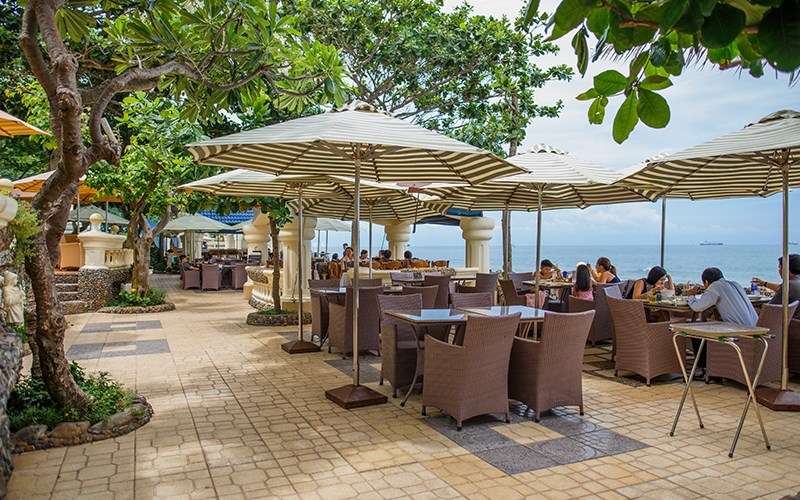
The main places to eat seafood are the casual cafés along Trần Phú, the beachside restaurants on Thùy Vân at Back Beach (Bãi Sau), the stingray hotpot shops on Nguyễn Trường Tộ and Trương Công Định, large seafront restaurants such as Gành Hào, and the night seafood market on Nguyễn Biểu. Each suits a different budget and mood, and the table below sets them out.
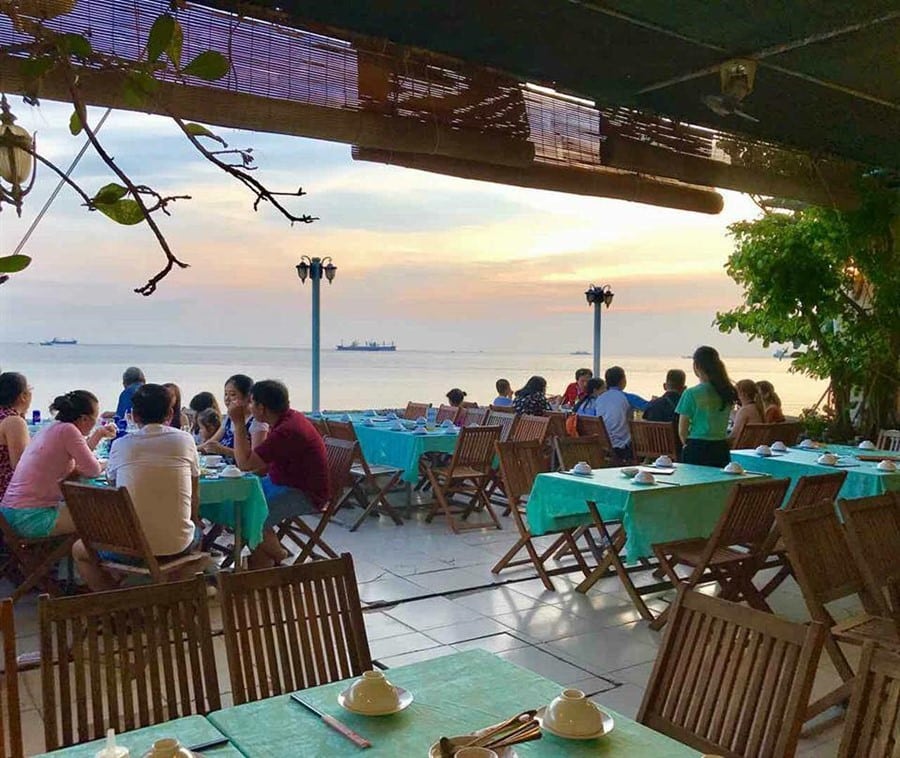
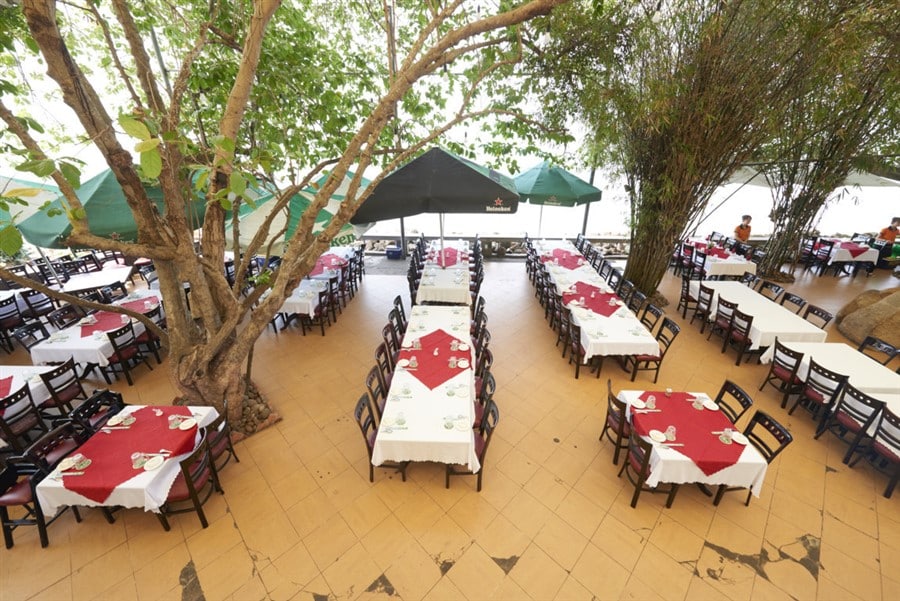
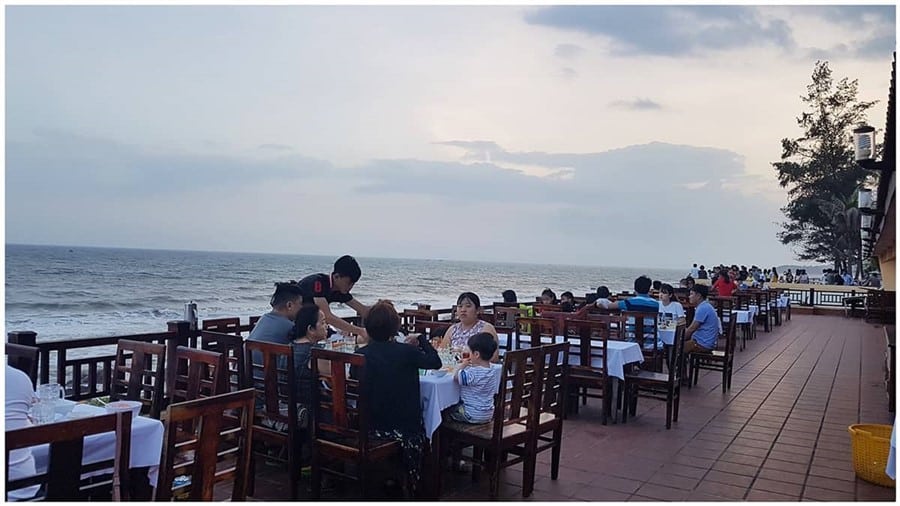
Photos: King Villa Vung Tau media library.
One note on addresses: since 1 July 2025, Vung Tau has been part of Ho Chi Minh City, and its wards were renamed (Vũng Tàu, Tam Thắng and Rạch Dừa wards, among others). Old addresses with “Phường 1” or “Phường 2” still circulate online and on signboards. To avoid confusion, search by street name and house number.
| Area | What it is known for and what to order | Budget for two | Best time |
|---|---|---|---|
| Trần Phú coast road, toward Bãi Dâu | Casual snail and seafood cafés facing the sea, such as Ốc Tự Nhiên, Thành Phát and Cây Bàng. Snails, grilled oysters, steamed clams, grilled squid. | 200,000–500,000 VND (about $7.70–19) | Late afternoon into sunset; open roughly 10:00–23:00 |
| Back Beach (Bãi Sau), Thùy Vân street | A strip of beachside seafood restaurants with live tanks. Crab, prawns and fish by weight after a swim. | Depends on the weight you pick; ask per-kg prices first | Lunch or early dinner; hours vary, check locally |
| Nguyễn Trường Tộ and Trương Công Định | The stingray hotpot cluster: Hoàng Minh (44 Trương Công Định), Út Mười (10 Trương Công Định), Bà Sáu (72 Nguyễn Trường Tộ), 7 Lượm (37 Nguyễn Trường Tộ). | 150,000–400,000 VND per pot (about $5.80–15.40) | Dinner; hours vary, check locally |
| Gành Hào, 3 Trần Phú and 9 Hạ Long | A large seafront restaurant with garden seating and live tanks. King crab (cua huỳnh đế) at 800,000–1,500,000 VND per kg, lobster sold in sets from about 3,000,000 VND. | 600,000–1,500,000 VND (about $23–58) | Sunset; open late morning to late evening, check |
| Bánh Khọt Gốc Vú Sữa, 14 Nguyễn Trường Tộ | The best-known bánh khọt shop in town. Bánh khọt with herbs and fish sauce. | 60,000–200,000 VND (about $2.30–7.70) | Weekday mornings; open about 07:00–15:30, with queues on weekends |
| Night seafood market, Nguyễn Biểu | Stalls selling live and ready-to-cook seafood by weight. | By weight; ask per-kg prices first | About 14:00 to midnight |
| Hoàng Diệu street | Oyster skillet (hàu né) shops. | From 45,000 VND per skillet (about $1.75) | Check locally |
Budgets and hours as of November 2026, check locally. Places are listed for what they are known for, not as endorsements.
The gallery at the top of this section gives a sense of the seafront options: tables at Cây Bàng as the sun goes down, the garden seating at Gành Hào, and terraces set over the rocks, such as the one at Lan Rừng. Trần Phú, the coast road from the Front Beach (Bãi Trước) side toward Bãi Dâu, faces the sunset, so tables fill from about 17:00. On weekends, arrive early or book ahead at the larger restaurants.
Back Beach is the long swimming beach on the east side, and the Thùy Vân restaurants serve people coming straight off the sand. It is convenient for families but also the most tourist-facing strip, so the pricing checklist further down matters most here. The hotpot streets, a short ride inland, feel more local.
If you are still choosing a base, our guide to where to stay in Vung Tau compares the main areas and how far each is from the markets and seafood streets.
Many visitors combine the coast with a few days in central Saigon. If you would like to add a street food evening or day tours in the city before or after the beach, Ho Chi Minh Tours lists options that pair well with a seafood weekend.
King Villa Vung Tau rents private pool villas for groups and families. Many of our villas have a kitchen and BBQ area; ask us which ones. That means your group can buy crab, prawns and squid at the market in the afternoon and grill them by the pool in the evening, at market prices and at your own pace.
Should you buy at the market and have it cooked?
Yes, if you are a group of four or more and do not mind a little effort: buying at the market and paying a cooking fee is usually the cheapest way to eat a lot of seafood in Vung Tau. For a couple who want one crab and a sea view, a restaurant is simpler and the saving is small.


Photos: 1) Bùi Thụy Đào Nguyên, CC BY-SA 3.0; 2) Phương Huy, CC0; 3) Phương Huy, CC BY-SA 4.0; 4) Phương Huy, Public domain; 5) Ji-Elle, CC BY-SA 4.0; via Wikimedia Commons.
Xóm Lưới Market (Chợ Xóm Lưới) is the seafood market most visitors use. It is near the corner of Phan Bội Châu and Nguyễn Công Trứ in the old center and trades from about 05:00 to 22:00. The best selection is early, about 05:00–08:00, and again from about 16:00 to 19:00 when afternoon stock arrives. Stalls around the market will cook what you buy for about 10,000–30,000 VND per kg, a little more for grilling, so you can eat on the spot or carry it away hot.
Bến Đình Market (Chợ Bến Đình) at 257 Lê Lợi is a wholesale-style market near the fishing harbor. It is busiest in the early morning and suits people buying in quantity. The Long Hải fishing-village market on Hai Bà Trưng in Long Hải, up the coast, opens from about 06:00 to 22:00. It has no on-site cooking, so it only makes sense if you are staying nearby with a kitchen.
As the photos at the top of this section show, the markets are not only about live Vung Tau seafood. Stalls here and on Long Sơn island also sell sun-dried squid and dried shrimp, which travel well as gifts, alongside stingray, shellfish and shrimp from the morning catch.
You have three ways to get a market purchase cooked: use a cooking stall beside the market; take it to a restaurant that offers gia công for 30,000–100,000 VND per dish (ask first, because not every restaurant accepts outside seafood); or grill it yourself at a villa with a kitchen and BBQ.
Bargaining is normal at markets and only at markets. Keep it modest, about 10–25 percent off the first price, and stay friendly. Markets and small stalls take cash or a VietQR bank transfer; cards work only at the larger restaurants. Tipping is not customary.
When is the best season for seafood in Vung Tau?
The best all-round season is the dry season, roughly November to April, and crab and prawns are generally at their best from December to March. Sweet sea snails (ốc hương) and razor clams are said to peak from May to October, while oysters, squid and fish are available all year. This calendar comes from limited sources, so treat it as a guide, not a guarantee.


Photos: 1) Xuanphuocle, CC0; 2) Willyvu, CC BY-SA 4.0; 3) Genghiskhanviet, Public domain; via Wikimedia Commons.
The views above, of the mountain rising behind Trần Phú, Back Beach near Hòn Bà islet and the bay at Front Beach, are the dry-season picture: calm water and clear evenings that suit outdoor tables. In the rainy months from May to October, showers usually pass quickly, but strong wind can keep small boats in harbor and may close the Long Sơn oyster rafts for a day or more. Supply drops and prices rise on those days. Prices also climb on weekends, public holidays and around Tết, when the city fills with visitors from Saigon.
How do you avoid being overcharged?
You avoid being overcharged by agreeing on three numbers before anything is cooked: the price per kg, the weight and the cooking fee. Most disputes over Vung Tau seafood bills come from a misunderstanding about weight, not from a secret price.
Two reported cases show how this happens. In February 2025, a customer at an eatery on Hoàng Hoa Thám was billed more than 1,400,000 VND (about $55) for four Japanese scallops. Tuoi Tre News reported that the listed price was 1,200,000 VND per kg and that the scallops weighed 1.2 kg; ward officials found that prices had been displayed. The lesson is that large imported shellfish weigh far more than they appear to. In 2026, SGGP reported that a crab seller in Long Hải was fined for using a non-standard scale and for not posting prices. That one is the less common but real risk: the scale itself.
A short checklist covers both:
- Ask the price per kg and the cooking fee before you choose anything.
- If the menu says “thời giá,” ask for today’s price and have it written down or typed on a phone.
- Repeat the agreed price out loud before the seafood goes on the scale.
- Watch the scale, and ask for the weight and the total before cooking.
- For big single items such as lobster, king crab and imported scallops, ask “Con này mấy ký?” (how heavy is this one?).
- Compare two or three stalls at a market.
- Check the bill for wet towels, peanuts and drinks you did not use.
Places that post prices clearly, weigh in front of you and write the weight on the order slip are doing what the rules require. If a seller will not give a per-kg price, move on; there is always another stall a few steps away.
Is seafood in Vung Tau safe to eat?
Seafood in Vung Tau is generally safe when it is alive before cooking and cooked through, which describes most of what restaurants and stalls serve. The usual travel precautions apply. Choose busy places with live tanks and fast turnover. Eat shellfish cooked: steamed, grilled or stir-fried. Raw oysters and gỏi cá mai carry a higher risk than cooked dishes, so skip them if you are pregnant, traveling with small children or have a sensitive stomach.
If anyone in your group has a shellfish allergy, say so clearly when ordering: “Tôi bị dị ứng hải sản” means “I am allergic to seafood.” Be aware that small kitchens cook everything on the same grills and in the same pots, so cross-contact is hard to rule out. At the market, live crabs should be moving, fish eyes should be clear, and shellfish should be closed or close when tapped.
How do you order seafood in Vietnamese?
You can order with about a dozen words: one question for the price, one for the weight and a short list of cooking styles. Staff at seafood places hear these phrases all day, and even rough pronunciation works when you point at the tank at the same time. A phone calculator settles any doubt about numbers.
- Bao nhiêu một ký? – How much per kilogram?
- Cân giúp tôi. – Please weigh it for me.
- Con này mấy ký? – How heavy is this one?
- Có phí chế biến không? – Is there a cooking fee?
- Hấp – steamed. Luộc – boiled. Nướng – grilled.
- Nướng mỡ hành – grilled with scallion oil.
- Rang me – with tamarind. Rang muối – salt-roasted.
- Xào sả ớt – stir-fried with lemongrass and chili. Cháy tỏi – fried with crisp garlic.
- Không cay. – Not spicy.
- Tôi bị dị ứng hải sản. – I am allergic to seafood.
- Tính tiền. – The bill, please.
As a rule of thumb, steaming suits crab, clams and mantis shrimp because it keeps the natural sweetness. Scallion oil suits oysters and scallops. Tamarind and salt-roasting suit crab and prawns with shells you will be licking anyway, and lemongrass with chili suits clams and snails.
A simple seafood day in Vung Tau
A full seafood day fits comfortably between breakfast and sunset without rushing. The plan below moves from light to heavy and puts the market visit in the afternoon window, when stock is fresh and the heat is easing.
| Time | What to eat | Where | Rough cost for two |
|---|---|---|---|
| 07:00 | Hủ tiếu mực (squid noodle soup) or bánh canh ghẹ (crab noodle soup) | A noodle shop near where you are staying | Bánh canh ghẹ 120,000–200,000 VND (about $4.60–7.70); hủ tiếu mực, check locally |
| 10:00 | Bánh khọt with herbs and fish sauce | Bánh Khọt Gốc Vú Sữa, 14 Nguyễn Trường Tộ, or another bánh khọt shop | 60,000–200,000 VND (about $2.30–7.70) |
| 16:00 | Market visit: crab, clams, squid or prawns by weight | Xóm Lưới Market (Chợ Xóm Lưới) | For example, 1 kg crab plus 1 kg clams: about 190,000–410,000 VND (about $7.30–15.80) before cooking |
| 17:30 | Sunset dinner: snails and grilled oysters, or the market haul on the grill | Trần Phú cafés, Gành Hào, or your villa BBQ | 200,000–500,000 VND at the cafés; 600,000–1,500,000 VND at Gành Hào |
| 20:00 (optional) | Lẩu cá đuối (stingray hotpot) to share | Nguyễn Trường Tộ or Trương Công Định | 150,000–400,000 VND (about $5.80–15.40) |
Costs as of November 2026, check locally.
Between meals there is plenty of time for the beach, the lighthouse or the cable car; our list of things to do in Vung Tau has ideas that fit around this eating schedule. If you are staying two nights, move the hotpot to the second evening and keep the first for the grill.
King Villa Vung Tau offers private pool villas sized for families and groups of friends. Many of our villas have a kitchen and BBQ area; ask us which ones. Tell us your group size and dates, and we will suggest a villa where you can bring seafood back from the market and grill it yourselves.
Frequently Asked Questions
What is the most famous food in Vung Tau?
Bánh khọt is the most famous food in Vung Tau. It is a crisp mini rice cake made with coconut milk, cooked in a round mould and topped with shrimp, shrimp powder and scallion. You wrap it in lettuce and herbs and dip it in sweet-sour fish sauce. A tray of 10–12 pieces costs about 30,000–100,000 VND, or about $1.15–3.85.
How much does a seafood dinner for two cost in Vung Tau?
A seafood dinner for two costs about 200,000–500,000 VND (about $7.70–19) at the casual cafés on Trần Phú and about 600,000–1,500,000 VND (about $23–58) at a large seafront restaurant such as Gành Hào. The total depends mostly on how much live seafood you order by weight. These are ranges as of November 2026, so check locally.
What does “thời giá” mean on a seafood menu?
“Thời giá” means “market price.” The restaurant has not printed a fixed number because the price of that item changes from day to day. Ask for today’s price per kilogram before you order, and ask how heavy your chosen crab, fish or lobster is, so you know the total before it is cooked.
Is there a cooking fee for seafood in Vung Tau?
Yes, a cooking fee usually applies when you buy raw seafood and have someone else cook it. Stalls at the market charge about 10,000–30,000 VND per kg, a little more for grilling. Restaurants that cook seafood you bring in charge about 30,000–100,000 VND per dish. In restaurants with their own tanks, cooking is normally included in the per-kg price.
Where is the best seafood market in Vung Tau?
Xóm Lưới Market (Chợ Xóm Lưới) is the seafood market most visitors use. It is near the corner of Phan Bội Châu and Nguyễn Công Trứ and opens from about 05:00 to 22:00. The best selection is from 05:00 to 08:00 and from 16:00 to 19:00. Stalls nearby will cook what you buy for a small fee per kilogram.
Can you bargain for seafood in Vung Tau?
You can bargain at markets, but not at restaurants. Keep it modest: about 10–25 percent off the first price is a realistic goal. Comparing two or three stalls works better than hard haggling, because sellers quote more carefully when they see you checking prices. Restaurant menu prices and posted per-kg prices are fixed.
Do seafood restaurants in Vung Tau accept credit cards?
Larger restaurants accept cards, but markets, street stalls and small cafés generally do not. They take cash or a VietQR bank transfer, which foreign visitors often cannot use. Carry enough Vietnamese dong in cash for market shopping and casual meals. Tipping is not customary, so the bill total is what you pay.
What is lẩu cá đuối?
Lẩu cá đuối is stingray hotpot, one of the signature dishes of Vung Tau. Pieces of stingray are simmered at the table in a sour and spicy broth with pickled bamboo shoots, then eaten with rice vermicelli and greens. It is served all year. A pot costs about 150,000–400,000 VND, or about $5.80–15.40, depending on size.
When is crab season in Vung Tau?
Crab is generally at its best from December to March, during the dry season, and the same is said of prawns. Crab is sold all year, but quality and price vary with the weather and holidays. Sweet sea snails and razor clams are reported to peak from May to October. Treat this calendar as a guide and ask sellers what is good that day.
Is it safe to eat raw oysters in Vung Tau?
Raw oysters carry a higher risk than cooked ones, in Vung Tau as anywhere. The safer choice is oysters grilled with scallion oil, cooked in porridge or served in a hot skillet. If you do eat raw shellfish or the raw anchovy salad gỏi cá mai, choose a busy place with fast turnover, and avoid them if you are pregnant or have a sensitive stomach.
Can you buy seafood and cook it at your villa?
Yes, buying seafood at the market and cooking it where you stay is common for groups. Check first that your accommodation has a kitchen or grill. At King Villa Vung Tau, many of our villas have a kitchen and BBQ area; ask us which ones. Buy in the 16:00–19:00 market window so the seafood goes straight onto the grill.
How do you say “how much per kilogram” in Vietnamese?
Say “Bao nhiêu một ký?” to ask how much something costs per kilogram. Follow it with “Con này mấy ký?” to ask how heavy a particular crab or fish is, and “Có phí chế biến không?” to ask whether there is a cooking fee. With those three questions answered, you know the full price before cooking starts.
Sources
- Vietnam Tourism – Ultimate guide to eating local in Vung Tau
- VnExpress International – 6 foods worth trying while staying in Vung Tau
- Tuoi Tre News – Authorities verify report of eatery offering 4 Japanese scallops at $56 in southern Vietnam
- VnExpress International – Why tourist price gouging rears its head every peak season
- SGGP – Lợi trước mắt, hại lâu dài (in Vietnamese)
- Ghiền Vũng Tàu – Chợ Xóm Lưới price guide (in Vietnamese)