The best things to do in Vung Tau go well past the sand: this guide lists 20 ideas, from a 32-meter hilltop statue reached by about 800 steps to tide-walk temples, cable cars, seafood markets, and day trips up the coast. The city sits about two hours from central Ho Chi Minh City by ferry or van.
- Since July 1, 2025, Vung Tau (Vũng Tàu) has been part of Ho Chi Minh City, following the merger with Bà Rịa–Vũng Tàu province. Addresses now read “Vũng Tàu ward, Ho Chi Minh City.”
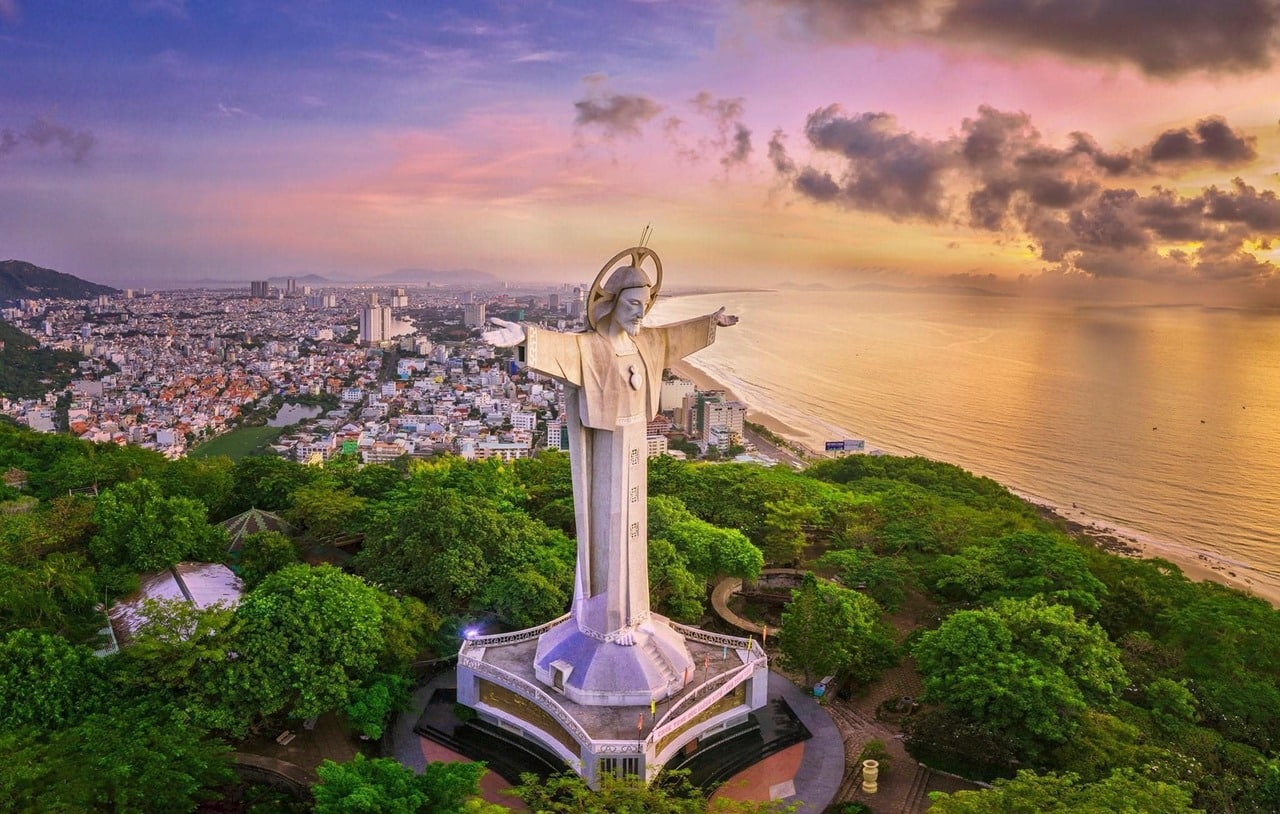
- The Christ of Vung Tau statue (Tượng Chúa Kitô Vua) is 32 meters tall, free to enter, and reached by about 800 outdoor steps plus 133 inside.
- The Ho May Park (Hồ Mây) cable car costs 100,000 VND round trip as of October 2026.
- The Greenlines DP ferry from Bạch Đằng pier takes about 2 hours and costs 320,000–350,000 VND one way as of August 2026.
- Dry season runs from November to April; rain is most likely from May to October.
- Weekends and public holidays are crowded. Weekdays are noticeably calmer at the statue, the cable car, and popular food spots.
The 20 things to do in Vung Tau at a glance
The 20 ideas fall into six groups: Small Mountain, temples, the coast, the old town, food, and day trips. Costs are the latest figures found and may have changed.
| Idea | Area | Cost (latest found, checked November 2026) | Time needed | Best time |
|---|---|---|---|---|
| 1. Christ of Vung Tau | Small Mountain | Free; parking fee | 1.5–2 hours | 7:00 a.m., weekdays |
| 2. Niết Bàn Tịnh Xá | Hạ Long Street | Free | 30–40 minutes | Morning |
| 3. Vung Tau Lighthouse | Small Mountain | Free; parking about 5,000 VND | 30–45 minutes | Late afternoon |
| 4. Nghinh Phong Cape | South tip | Free; paid parking | 30–60 minutes | Early morning |
| 5. Thích Ca Phật Đài | Big Mountain | Free | 1–1.5 hours | Morning |
| 6. Hòn Bà temple | Off Back Beach | Free on foot | 1–2 hours | Low tide only |
| 7. Front Beach and the coast road | Hạ Long Street | Free | 1–2 hours | Sunset |
| 8. Surfing at Back Beach | Back Beach | Ask schools | 2 hours | November–April |
| 9. Sea-view coffee | Hải Đăng, Hạ Long, Trần Phú | From 20,000 VND | 1 hour | Late afternoon |
| 10. White Palace | Trần Phú Street | 15,000 VND | 45–90 minutes | Morning |
| 11. Ho May Park cable car | Big Mountain | 100,000 VND cable car only | 2–4 hours | Weekday morning |
| 12. Bà Rịa–Vũng Tàu Museum | Trần Phú Street | 40,000 VND | 1 hour | Midday heat |
| 13. Worldwide Arms Museum | Trần Hưng Đạo Street | 70,000 VND | 1 hour | Midday heat |
| 14. Bánh khọt | Town center | 30,000–100,000 VND a tray | 45 minutes | Breakfast or lunch |
| 15. Stingray hotpot and crab noodles | Town center | 60,000–320,000 VND | 1 hour | Dinner |
| 16. Seafood markets | Xóm Lưới, Bến Đình | Varies by weight | 1–1.5 hours | 5:00–7:00 a.m. or 4:00–6:00 p.m. |
| 17. Long Sơn floating rafts | Long Sơn island | Seafood by weight | Half day | Lunch |
| 18. Long Hải: Dinh Cô and Minh Đạm | Long Hải | Free | Half day | Morning |
| 19. Hồ Tràm, Hồ Cốc, Bình Châu hot springs | Northeast coast | 165,000–240,000 VND at the springs | Full day | Weekdays |
| 20. Côn Đảo by boat | Offshore | 555,000–950,000 VND one way | 2+ days | Calm-sea days |
What are the best things to do in Vung Tau on Small Mountain?
Small Mountain (Núi Nhỏ), the hill at the southern tip of the peninsula, holds four of the city’s best-known sights within a couple of kilometers: the Christ statue, a seaside pagoda, the French lighthouse, and Nghinh Phong Cape. You can link them in one morning by motorbike or taxi.
1. Climb the Christ of Vung Tau statue (Tượng Chúa Kitô Vua)
The statue stands 32 meters tall with an arm span of 18.3 meters. Entry is free, with donation boxes and a parking fee at the foot of the hill. About 800 stone steps lead up, and a 133-step spiral staircase inside reaches small balconies on the shoulders. Published hours are 7:00 a.m. to 5:00 p.m. as of July 2026, with last entry inside around 4:30 p.m. One guide lists a lunch break from 11:30 a.m. to 1:00 p.m., so arrive before 11:00 a.m. or after 1:30 p.m. To go inside, cover shoulders and knees, remove your shoes, and leave large bags outside.
2. See the reclining Buddha at Niết Bàn Tịnh Xá
Niết Bàn Tịnh Xá (Nirvana Vihara) at 66/7 Hạ Long Street was built between 1969 and 1974 on the seaward slope of Small Mountain. Its centerpiece is a 12-meter reclining Buddha. The grounds also hold a bronze bell weighing about 3.5 tons and a 12-meter stone “Prajna boat” (thuyền Bát Nhã). Entry is free. Sources give different opening hours, so visit between 8:00 a.m. and 5:00 p.m. to be safe, and allow 30 to 40 minutes. It is roughly a kilometer from the foot of the Christ statue steps.


Photos: 1) BrightRaven, CC BY 3.0; 2) BrightRaven, CC BY 3.0; 3) RG72, CC BY-SA 4.0; via Wikimedia Commons.
3. Catch the view from the Vung Tau Lighthouse (Hải Đăng Vũng Tàu)
The French built this white, 18-meter lighthouse on top of Small Mountain in 1862. A narrow road winds up to it, and the terrace looks over both Front Beach and Back Beach. Entry was free with motorbike parking around 5,000 VND as of July 2026. Opening hours are loosely kept and guides disagree, so plan a daytime visit between 7:30 a.m. and 5:00 p.m. and treat sunset access as a bonus. Allow 30 to 45 minutes.
4. Walk down to Nghinh Phong Cape (Mũi Nghinh Phong) and the “Gate of Heaven”
Nghinh Phong Cape is the rocky southern point of the peninsula, at the end of Hạ Long Street across from the Christ statue. A slope and a flight of steps lead down toward the sea, passing the stone gateway locals call the “Gate of Heaven” (Cổng Trời), a popular photo frame with the ocean behind it. Entry is free and parking is paid as of April 2026. The wind is strong year-round and currents are unpredictable, so come for the view, not a swim.
Which temples and pagodas are worth visiting?
Two stand out beyond Niết Bàn Tịnh Xá: Thích Ca Phật Đài, a large hillside Buddhist complex, and the tiny Hòn Bà temple on an islet you can sometimes reach on foot. Both are free. Dress modestly at each, with shoulders and knees covered.
5. Wander the gardens of Thích Ca Phật Đài
Thích Ca Phật Đài spreads over about 28 hectares on the slope of Big Mountain (Núi Lớn), along Trần Phú Street. Paths climb past statues showing scenes from the Buddha’s life to a 6-meter seated Buddha on a 7-meter pedestal. Behind it grows a bodhi tree planted in 1960. Entry is free, and listed hours are 7:00 a.m. to 5:00 p.m. as of July 2026. Much of the route is in full sun, so bring water. Allow an hour to an hour and a half.


Photos: 1) Balou46, CC BY-SA 3.0; 2) Bùi Thụy Đào Nguyên, CC BY-SA 4.0; 3) Bùi Thụy Đào Nguyên, CC BY-SA 4.0; via Wikimedia Commons.
6. Walk across the sea to Hòn Bà temple (Miếu Hòn Bà)
Hòn Bà is a small islet about 200 meters off the southern end of Back Beach (Bãi Sau), topped by a shrine. At the lowest tides, typically around the 14th and 15th days of the lunar month, a rocky path appears for two to three hours and people walk across. Clock times change with each date, so check a tide table for the day you plan to go. The walk is free. When the path is underwater, local boats charged about 500,000 VND per group as of February 2026. Wear sandals with grip, because the rocks are slippery and covered in sharp oyster shells, and head back before the tide turns.
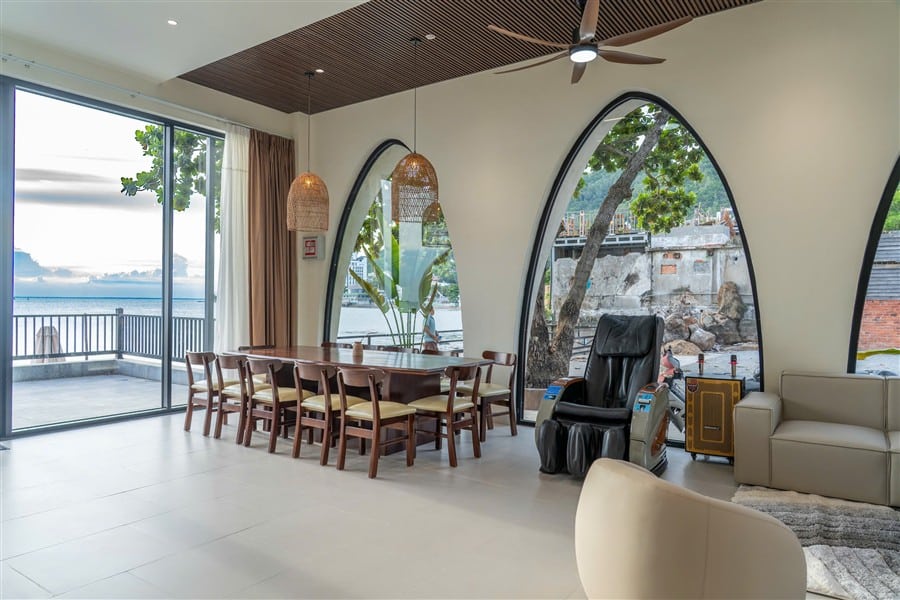
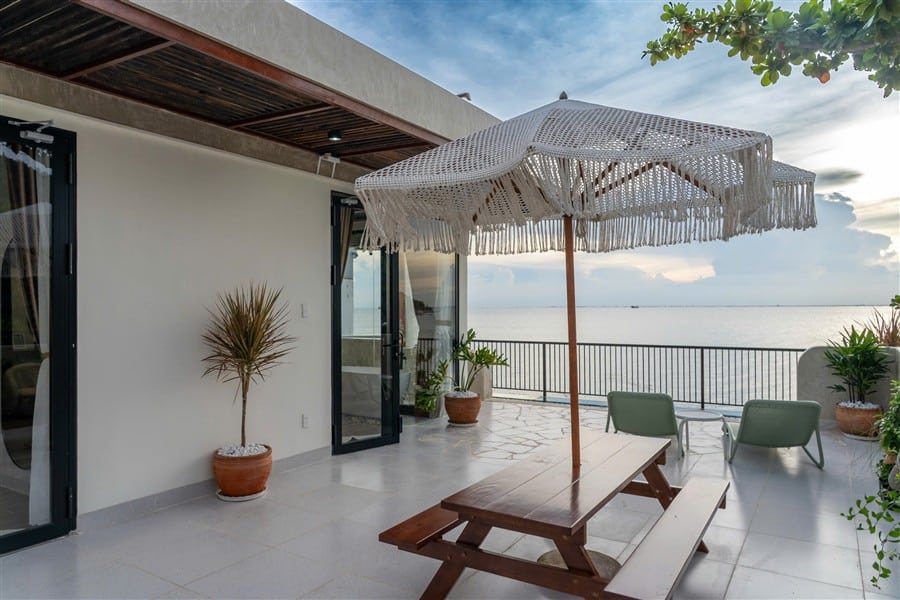
King Villa Vung Tau rents private villas with pools for families and groups of friends, so everyone can stay under one roof between outings. Message us with your dates and group size and we will suggest a villa that fits.
What can you do on the coast besides swimming?
You can walk the Front Beach promenade at sunset, follow the coast road around Small Mountain on two wheels, try board sports at Back Beach in the windy months, or sit with a coffee above the water. None of these needs a ticket.
7. Stroll Front Beach (Bãi Trước) at sunset and follow the coast road
Front Beach faces west, which makes it the city’s sunset side. The seafront park here is where residents come to walk in the evening. From its southern end, Hạ Long Street curves around the base of Small Mountain, passing Pineapple Beach (Bãi Dứa) and Niết Bàn Tịnh Xá before reaching Nghinh Phong Cape. From there, Thùy Vân Street runs north along Back Beach. The loop is a pleasant ride by bicycle or motorbike. Go early or late in the day, since there is little shade and weekend traffic on Thùy Vân can be slow.
8. Try surfing at Back Beach (Bãi Sau)
Back Beach faces the open sea and gets the city’s most consistent waves. The dry season from November to April is the better period for surfing, and November is often cited as the prime month. The same northeast winds draw kitesurfers. Local schools offer surf, stand-up paddle, and kite lessons, though prices and exact locations vary by season, so contact them directly before you travel. Swimmers should stay between the lifeguard flags, since this beach has known rip currents.
9. Have coffee with a sea view
Cafés cluster in three areas: Hải Đăng Street on the way up to the lighthouse, Hạ Long Street above Pineapple Beach, and Trần Phú Street north of Front Beach. Names to look for include The View Hải Đăng, Lightroom Coffee, SOHO Coffee, Gazebo, and Mi Amor Beach. Most open from about 7:00 a.m. to 11:00 p.m. as of April 2026. A basic iced coffee with condensed milk (cà phê sữa đá) runs 20,000 to 35,000 VND at ordinary shops as of August 2026, and view cafés charge more.


Photos: 1) trungydang, CC BY 3.0; 2) Phó Nháy, public domain; 3) Xuanphuocle, CC0; 4) Phương Huy, public domain; 5) Phương Huy, public domain; via Wikimedia Commons.
What is there to see in the old town and on Big Mountain?
The northern end of Front Beach packs a colonial villa, a cable car, and two museums into a short stretch around Trần Phú and Trần Hưng Đạo streets. These are good choices for the hot middle of the day or a rainy afternoon.
10. Tour the White Palace (Bạch Dinh)
The French built this hillside villa between 1898 and 1902 as a residence for the governor-general. Emperor Thành Thái was later held here under house arrest. Tickets cost 15,000 VND as of July 2026. Guides list opening times of either 7:00 or 7:30 a.m. to 5:00 p.m., so arrive after 7:30 a.m. Allow 45 to 90 minutes for the rooms and the wooded grounds.
11. Ride the cable car to Ho May Park (Hồ Mây)
The cable car station at 1A Trần Phú lifts you to a hilltop park on Big Mountain with gardens, rides, and wide views of the bay. As of October 2026, a cable car round trip costs 100,000 VND, and an all-inclusive ticket costs 475,000 VND for adults and 237,500 VND for children between 100 and 130 centimeters. The park opens at 8:00 a.m. and runs into the evening. Weekday mornings are quiet. On Sunday afternoons, expect to queue 30 to 40 minutes.
12. Cool off in the Bà Rịa–Vũng Tàu Museum
At 4 Trần Phú Street, this four-floor museum covers the region from prehistory to the present. Highlights include ceramics recovered from shipwrecks off the coast. Tickets were 40,000 VND as of March 2025. On weekdays the museum has closed for lunch from 11:30 a.m. to 1:30 p.m., so mid-morning or mid-afternoon is the safer time to visit.
13. Browse the Worldwide Arms Museum (Bảo tàng Vũ khí cổ Robert Taylor)
British collector Robert Taylor opened this private museum in 2012 in a French-style villa at 98 Trần Hưng Đạo. It displays about 4,000 antique weapons and uniforms from many countries. A Vietnamese newspaper described visitors touring it in April 2026. Listed hours were 8:00 a.m. to 5:00 p.m. and tickets 70,000 VND for ages 12 and up as of August 2025. Confirm both before you go.
What should you eat in Vung Tau and where?
Start with three local dishes: bánh khọt, stingray hotpot, and crab noodle soup. Then visit a seafood market to buy your own. All prices in this section are as of August 2026.
14. Order a tray of bánh khọt
Bánh khọt are small, crisp rice-flour cakes topped with shrimp, eaten wrapped in lettuce and herbs with sweet fish sauce. A tray of 10 to 12 costs 30,000 to 100,000 VND. Bánh Khọt Gốc Vú Sữa at 14 Nguyễn Trường Tộ is the best-known shop and closes around 3:30 p.m. It draws long weekend lines.
15. Share a stingray hotpot or a bowl of crab noodle soup
Lẩu cá đuối is a sour, lightly spicy hotpot of stingray with bamboo shoots and greens. A pot costs 145,000 to 320,000 VND and feeds two or more. Lẩu Cá Đuối Hoàng Minh at 44 Trương Công Định does not take reservations and gets busy between 7:00 and 9:00 p.m. on weekends. For something lighter, bánh canh ghẹ is a thick tapioca-noodle soup with blue swimmer crab, at 60,000 to 100,000 VND a bowl. Bánh Canh Ghẹ Cây Khế at 27 Hoàng Hoa Thám is one place to try it.


Photos: 1) Phương Huy, CC BY-SA 4.0; 2) Bùi Thụy Đào Nguyên, CC BY-SA 3.0; 3) Bùi Thụy Đào Nguyên, CC BY-SA 3.0; via Wikimedia Commons.
16. Shop the seafood markets at Xóm Lưới and Bến Đình
Xóm Lưới Seafood Market (Chợ hải sản Xóm Lưới), at the corner of Nguyễn Công Trứ and Phan Bội Châu, is the easiest for visitors. It runs from about 5:00 a.m. into the evening. Pick live crab, prawns, or squid by weight, then pay a nearby stall 30,000 to 100,000 VND per dish to cook it. Bến Đình Market, beside the fishing port, is more local and cheaper, and is busiest when boats land around 4:00 to 5:00 a.m. and 4:00 to 5:00 p.m.
Which day trips from Vung Tau are worth it?
Four are worth the drive or boat ride: the Long Sơn floating rafts, the temple and wartime caves at Long Hải, the beaches and hot springs on the northeast coast, and Côn Đảo for those with two days or more. If you are comparing Vung Tau with other escapes from Saigon, the day-trip guides on hochiminhtours.com cover the Mekong Delta, Cu Chi, and other options.
17. Eat lunch on the Long Sơn floating rafts (Làng bè Long Sơn)
Long Sơn island, northwest of the city center, is ringed with fish and oyster farms. Several rafts double as restaurants: you walk along the cages, point at what you want, and the kitchen steams or grills it. Oysters are the specialty and started at about 26,000 VND each as of August 2026. Most raft restaurants serve from morning to early evening. Ask the price per kilogram before you order.
18. Visit Dinh Cô temple and the Minh Đạm caves at Long Hải
Long Hải is a fishing town across the bay. Dinh Cô temple, on a hillside above the beach, honors a young woman revered by local fishermen. Its annual festival, held in the second lunar month, ran from March 27 to 30 in 2026 and drew more than 378,000 visitors. About 30 kilometers from Vung Tau, the Minh Đạm mountains hide a wartime base with caves, trails, and a memorial temple. Entry was free as of August 2025. Long Hải is also known for dried seafood, sold at stalls around town.


Photos: 1) Bùi Thụy Đào Nguyên, CC BY-SA 3.0; 2) trungydang, CC BY 3.0; 3) Vasily Michel, CC0; 4) Van Twin, CC BY-SA 3.0; via Wikimedia Commons.
19. Drive the coast to Hồ Tràm, Hồ Cốc, and Bình Châu hot springs
Past Long Hải, the coast road continues northeast to the long, quieter beaches of Hồ Tràm and Hồ Cốc, backed by forest and resort hotels. At the far end, Minera Hot Springs Bình Châu has mineral pools and mud baths. Entry was 165,000 VND Monday to Thursday, 200,000 VND Friday to Sunday, and 240,000 VND on holidays as of January 2026, with lower child prices. Pools run from about 9:00 a.m. to 6:00 p.m. Bring a dark swimsuit and a change of clothes. Weekdays are cheaper and less crowded than weekends. The drive is long enough that it works best as a full day, with a beach stop at Hồ Tràm or Hồ Cốc on the way there or back.
20. Take the boat to Côn Đảo
Côn Đảo, the island group known for its former prison and clear water, has a high-speed boat link from Vung Tau. As of March 2026, the Thăng Long ship left Vung Tau at 7:30 a.m. and returned at 1:00 p.m., with no Monday sailings. Regular one-way fares ranged from 555,000 to 790,000 VND on weekdays and 665,000 to 950,000 VND on weekends. Sailings depend on sea conditions. Confirm the schedule, crossing time, and departure pier with the operator when you book, and stay at least one night. Fares are lower for children and seniors, and a VIP cabin cost 1,100,000 VND at the regular rate. Seas are rougher in some months, so keep your plans flexible and avoid booking a tight onward connection for the day you return. Travelers who get seasick, or who are short on time, can fly to the islands from Ho Chi Minh City instead and keep Vung Tau as a separate beach stop on the same trip.


Photos: 1) Bùi Thụy Đào Nguyên, CC BY-SA 3.0; 2) Bùi Thụy Đào Nguyên, CC BY-SA 3.0; 3) Tycho, CC BY-SA 3.0; 4) Tycho, CC BY-SA 3.0; via Wikimedia Commons.
How do you get from Ho Chi Minh City to Vung Tau?
You have three practical choices: the Greenlines DP ferry, a limousine van, or a private car on the new expressway. Each takes roughly one and a half to two and a half hours. Figures below are as of August 2026.
| Option | From | Time | Price (as of August 2026) | Notes |
|---|---|---|---|---|
| Greenlines DP ferry | Bạch Đằng pier, District 1, to Hồ Mây pier | About 2 hours | 320,000 VND weekdays; 350,000 VND weekends | A few sailings a day; can be canceled in bad weather |
| Limousine van (9 seats) | City-center pickup points | About 2 hours 15 minutes | 140,000–290,000 VND | Frequent departures; book ahead on weekends |
| Private car or ride-hail | Door to door | 70–90 minutes | About 1.2–1.5 million VND for a 4-seat car | Uses the Biên Hòa–Vũng Tàu expressway, fully open since May 2026 |
The ferry is the scenic choice and lands next to the Ho May cable car station. It typically leaves Ho Chi Minh City at about 9:00 a.m. and noon, with an extra afternoon sailing on weekends, though the operator does not publish a fixed timetable. Vans are the best value for solo travelers and couples. For a group, splitting a car is usually the fastest option.
When is the best time to visit Vung Tau?
November to April is the most reliable period, with dry weather and steady sea breezes. From May to October, expect rain, usually in short, heavy bursts, and occasional ferry cancellations. The sea is warm enough to swim all year.
The day of the week matters as much as the month. Vung Tau is the closest beach to Ho Chi Minh City, so Saturdays, Sundays, and public holidays bring heavy crowds and higher room rates. From Monday to Thursday, the statue steps, the cable car, and the bánh khọt shops are far easier.
- Xin chào (sin chow): hello
- Cảm ơn (gahm uhn): thank you
- Bao nhiêu tiền? (bow nyew tee-en): how much is it?
- Một ký bao nhiêu? (moht kee bow nyew): how much per kilogram?
- Không cay (khohm kai): not spicy
- Tính tiền (tin tee-en): the check, please
This list is a menu of ideas, not a schedule. For a day-by-day plan, see our Vung Tau weekend itinerary. To choose a base, read where to stay in Vung Tau, or look at private villa rental in Vung Tau if you are traveling with a group.
Frequently Asked Questions
What is Vung Tau best known for?
Vung Tau is best known as the closest beach city to Ho Chi Minh City, about two hours away. Its signature sights are the 32-meter Christ of Vung Tau statue on Small Mountain, the 1862 French lighthouse, the White Palace, and Back Beach. It is also known for seafood and for bánh khọt, small crisp rice cakes topped with shrimp.
How many days do you need in Vung Tau?
Two days cover the main sights in town at a relaxed pace: Small Mountain and the temples one day, the old town, cable car, and food the next. Add a third day if you want a day trip to Long Hải, the Long Sơn rafts, or the Bình Châu hot springs. Côn Đảo needs at least two more days because of the boat schedule.
Is Vung Tau worth visiting if you do not like beaches?
Yes. More than half of the 20 ideas in this guide have nothing to do with swimming. You can climb to the Christ statue, visit three Buddhist sites, tour a colonial villa and two museums, ride a cable car, shop the seafood markets, and take day trips to wartime caves and hot springs. The food alone justifies a short visit.
How many steps are there to the Christ of Vung Tau statue?
There are about 800 stone steps from the foot of Small Mountain to the base of the statue, with some guides counting 811. Inside the statue, a narrow spiral staircase of 133 more steps leads to the balconies on the shoulders. Take it slowly, carry water, and start early to avoid the midday heat.
Is there a dress code for the Christ statue?
Yes, for going inside. Cover your shoulders and knees: shorts, mini skirts, and sleeveless tops are turned away at the door. You also need to take off your shoes and leave large bags outside before climbing the inner staircase. The outdoor steps and the terrace around the base have no strict dress rule, but modest clothing is respectful at a religious site.
How much does the Ho May Park cable car cost?
As of October 2026, a round-trip cable car ticket costs 100,000 VND for adults and 50,000 VND for children between 1 and 1.3 meters tall. An all-inclusive ticket covering the rides and attractions at the top costs 475,000 VND for adults and 237,500 VND for children.
When can you walk to Hòn Bà island?
Only at very low tide, which typically falls around the 14th and 15th days of each lunar month. The rocky path is exposed for roughly two to three hours, and the clock time shifts with each date, so check a tide table before you go. Wear sturdy sandals, cross early in the window, and return well before the water rises.
What food should you try in Vung Tau?
Try bánh khọt first, at 30,000 to 100,000 VND a tray as of August 2026. Then share a stingray hotpot (lẩu cá đuối), at 145,000 to 320,000 VND a pot, and have a bowl of crab noodle soup (bánh canh ghẹ) for 60,000 to 100,000 VND. Fresh oysters, grilled or in porridge, are another local favorite.
How do you get from Ho Chi Minh City to Vung Tau?
The three main options are the Greenlines DP ferry from Bạch Đằng pier, which takes about 2 hours and costs 320,000 to 350,000 VND; a 9-seat limousine van, at about 2 hours 15 minutes and 140,000 to 290,000 VND; or a private car on the expressway, at 70 to 90 minutes. Prices are as of August 2026.
Is Vung Tau part of Ho Chi Minh City now?
Yes. On July 1, 2025, Bà Rịa–Vũng Tàu province merged into Ho Chi Minh City, along with Bình Dương. The former Vung Tau city is now a set of wards within the enlarged Ho Chi Minh City. Many maps, websites, and signs still use the old provincial address, so you will see both versions for the same place.
What is the best month to visit Vung Tau?
December through March offers the most dependable weather, with dry days and little rain. The wider dry season runs from November to April. May to October is wetter, though showers are often short. Whatever the month, a weekday visit is calmer than a weekend, and public holidays such as Tết and April 30 are the busiest times of the year.
Can you visit Côn Đảo from Vung Tau?
Yes, by high-speed boat. As of March 2026, the Thăng Long ship sailed from Vung Tau at 7:30 a.m. and returned from Côn Đảo at 1:00 p.m., except on Mondays. Regular one-way fares ranged from 555,000 to 950,000 VND depending on the day and passenger type. Because of the timetable, a same-day round trip leaves no time on the island.
Sources
- VietnamSpot: Vung Tau attractions, hours and prices (updated 2026)
- VietnamSpot: Getting to Vung Tau by ferry, van and expressway (updated August 2026)
- Local Vietnam: Jesus Christ Statue Vung Tau travel guide (August 2025)
- Sài Gòn Giải Phóng: Visiting the antique arms museum in Vũng Tàu ward (April 2026)
- Sài Gòn Giải Phóng: Dinh Cô Festival 2026 visitor figures (May 2026)
- Tuổi Trẻ: Vũng Tàu–Côn Đảo high-speed boat fares and schedule (March 2026)
Cover photo: Nghinh Phong Cape, Hoangvantoanajc, CC BY-SA 3.0, via Wikimedia Commons.
King Villa Vung Tau rents private villas with pools, a practical base for families and groups who want to cook their market seafood, swim, and head out to the sights above. Send us your dates and group size for availability.